



Fun facts about trampolines – from the circus to the Olympics
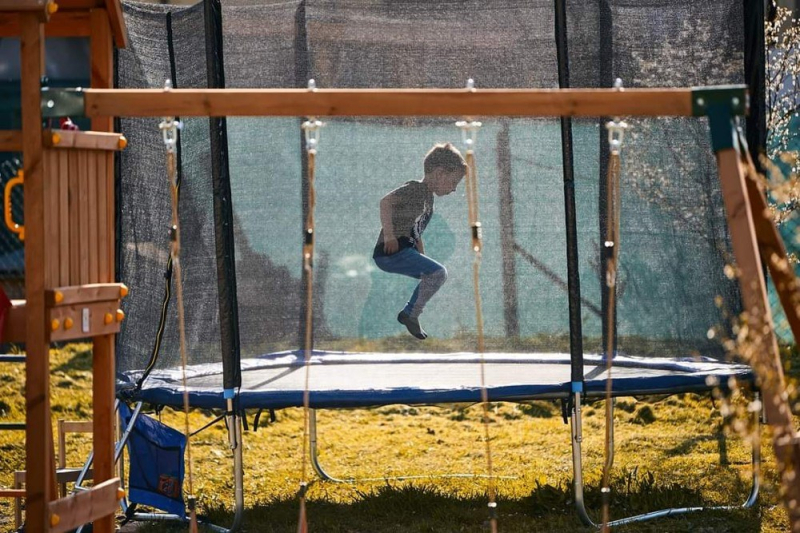
The trampoline in the garden looks like the most ordinary children's fun. Behind it, though, there are circus acts, military pilots, astronauts and Olympic medals. We have gathered a few facts you can surprise the kids with the next time they jump.
Before the trampoline: walrus skin and firefighters' nets
People were bouncing on a stretched surface long before springs appeared. The Inuit in Alaska toss a person into the air on a stretched walrus skin – part of the celebration after the spring whale hunt. In 1887 the life nets were invented, with which firefighters caught people jumping from burning buildings. And in the circus, aerial acrobats finish their act with a rebound off the safety net.
Who invented the trampoline
It was exactly such a circus net that the young American gymnast George Nissen was watching when he imagined an apparatus on which the rebound could be repeated again and again. In 1934, together with his coach Larry Griswold, he put together the first prototype – an iron frame, canvas and strips of car inner tubes instead of springs. (Some sources give 1936.) Among the first to try it were the children at a summer camp.
The name came a few years later. On a tour in Mexico, Nissen heard the Spanish word trampolín – a diving board – and registered its English version, trampoline, as a trademark. Today the apparatus goes by that name in many languages.
From pilots to astronauts
During the Second World War the US Navy used trampolines in its schools for pilots and navigators – this way they got used to orienting themselves in space while turning over. After the war, both American and Soviet astronauts trained on trampolines. Together with astronaut Scott Carpenter, Nissen even invented a ball game on a trampoline – Spaceball – which became part of NASA's training.
When the trampoline became a sport
- 1948 – the first national championship in the USA.
- 1964 – the first world championship, at London's Royal Albert Hall. The winners were two Americans – Judy Wills and Dan Millman.
- 2000 – trampoline made its debut at the Olympic Games in Sydney. George Nissen was 86 and watched from the stands.
- 2008 – in Beijing, Nissen was invited to try the Olympic trampoline before the competition began.
A competitor's routine consists of ten different jumps one after another. Difficulty and execution are scored, and since 2010 electronics have also measured the time spent in the air. The competition trampoline is rectangular, with a bed of 4.28 by 2.14 m, and good athletes fly up to a height of 10 metres – as high as a three-storey building.
A few records
- 3,333 somersaults without a break – Brian Hudson from Great Britain, 18 September 2003.
- 6.73 m – the highest bounce in which two people "launch" a third. The record belongs to the Americans Sean, Eric and T.J. Kennedy, from 2014.
- 58.6 m – the longest permanent trampoline in the world, opened in the spring of 2026 at an entertainment centre in Winnipeg, Canada.
All three are listed in the Guinness World Records.
From children's fun to fitness tool
In the late 1950s the first paid trampoline venues appeared in North America – the forerunners of today's trampoline parks. The fashion passed quickly and only came back in our time: in 2011 there were a few dozen parks in the USA, and by 2014 – already close to 300.
The small indoor trampoline, about a metre in diameter, was invented as early as 1938, but became truly popular in the early 1980s. Back then more than a million were sold in the USA every year and jumping turned into a workout for adults. A 1980 study by NASA scientists helped too. They compared jumping on a trampoline with running on a treadmill and found that, at the same heart rate and oxygen consumption, the workload on the trampoline is greater and is spread more evenly over the body – without the strong impact on the ankles that comes with running.
And at home?
You do not need to think about records. For children, the trampoline is above all outdoor play, and balance and coordination come along with it. What matters is that it has a safety net, is the right size for the garden and that children jump one at a time. You will find more in the articles How to choose a garden trampoline and 7 benefits of a trampoline for children.
Take a look at the Buba trampolines and the trampoline accessories.
Comments: 0